Numerical Limits
-
Guess the value of the limit:
\(\displaystyle{\lim_{x \to 2} (3x - 5)}\)
View Solution
-
Guess the value of the limit:
\(\displaystyle{\lim_{x \to -3} \frac{5x+1}{2x-1}}\)
View Solution
-
Guess the value of the limit:
\(\displaystyle{\lim_{x \to 0} \frac{\sin x}{x}}\)
View Solution
Graphical Limits
-
For the function \( f \) whose graph is given below, state the value of each, if it exists.
View Solution
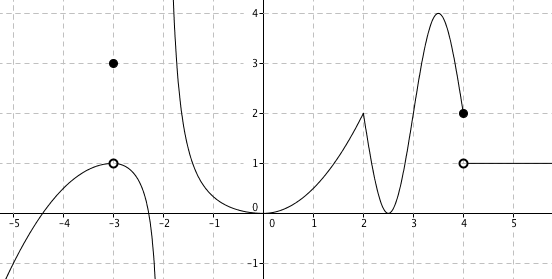 (a) \(\displaystyle\lim_{x \to -2^+} f(x)\)
(b) \(\displaystyle\lim_{x \to -2^-} f(x)\)
(c) \(\displaystyle\lim_{x \to -2} f(x)\)
(a) \(\displaystyle\lim_{x \to -2^+} f(x)\)
(b) \(\displaystyle\lim_{x \to -2^-} f(x)\)
(c) \(\displaystyle\lim_{x \to -2} f(x)\)
(d) \(\displaystyle\lim_{x \to -3} f(x)\)
(e) \(\displaystyle\lim_{x \to 4^-} f(x)\)
(f) \(\displaystyle\lim_{x \to 4^+} f(x)\)
(g) \(\displaystyle\lim_{x \to 4} f(x)\)
(h) \(\displaystyle\lim_{x \to 2} f(x)\)
(i) \(f(-3)\)
-
Sketch the graph of a function \( f \) that satisfies all of the given conditions.
I. \(\displaystyle\lim_{x \to 0^-} f(x) = -2,\;
\lim_{x \to 0^+} f(x) = 1,\;
f(0) = 3\)
View Solution
II. \(\displaystyle\lim_{x \to 5^+} f(x) = 4,\;
\lim_{x \to 5^-} f(x) = 3,\;
\lim_{x \to -2} f(x) = 5,\;
f(5) = 4,\;
f(-2) = -1\)
View Solution
III. \(\displaystyle\lim_{x \to 0} f(x) = 1,\;
f(0) = 2,\;
\lim_{x \to 3^+} f(x) = \infty,\;
\lim_{x \to 3^-} f(x) = -\infty,\;
f(-1) = 0\)
View Solution
Infinite Limits
-
Determine the infinite limit.
View Solution
(a) \(\displaystyle{ \lim_{x \to 3^+} \frac{x+1}{x-3}}\)
(b) \( \displaystyle{\lim_{x \to 2^-} \frac{1}{x-2}}\)
-
Determine the infinite limit. View Solution
(a) \(\displaystyle{\lim_{x \to 2} \frac{3-x}{(x-2)^2}}\)
(b) \( \displaystyle{\lim_{x \to 2^+} \ln(x^2 - 4)}\)
-
Evaluate the one-sided limits for
\( \displaystyle f(x) = \frac{2}{x^3 - 1} \).
View Solution
(a) \(\displaystyle{\lim_{x \to 1^-} f(x)}\)
(b) \(\displaystyle \lim_{x \to 1^+} f(x)\)