Fundamental Theorem of Calculus
- Find the derivative, \(g'(x) \), of each of the following functions. solution
(a) \( \displaystyle g(x) =\int_2^x (5t-\ln t + 7) \, dt \) (b) \( \displaystyle g(x) =\int_x^4 \frac{\tan t}{1+t^2} \, dt \) (c) \( \displaystyle g(x) =\int_5^x \sqrt{1-t+2t^2} \, dt \)
- Find the derivative \( g'(x)\) of the function. solution
(a) \(\displaystyle{ g(x)=\int_1^x \sqrt{3t^2+t^4} \, dt }\) (b) \(\displaystyle{ g(x)=\int_x^2 \frac{5-\sin t }{\cos t +2t}\, dt }\) (c) \( \displaystyle{g(x)=\int_1^{2x} (2-5t+7t^2 ) \, dt} \)
(d) \( \displaystyle{g(x)=\int_{e^x}^{0} 5 \cos^3(t) \, dt} \)
- Consider the following graph of \(y=f(t)\) for the following
(a)-(e). solution
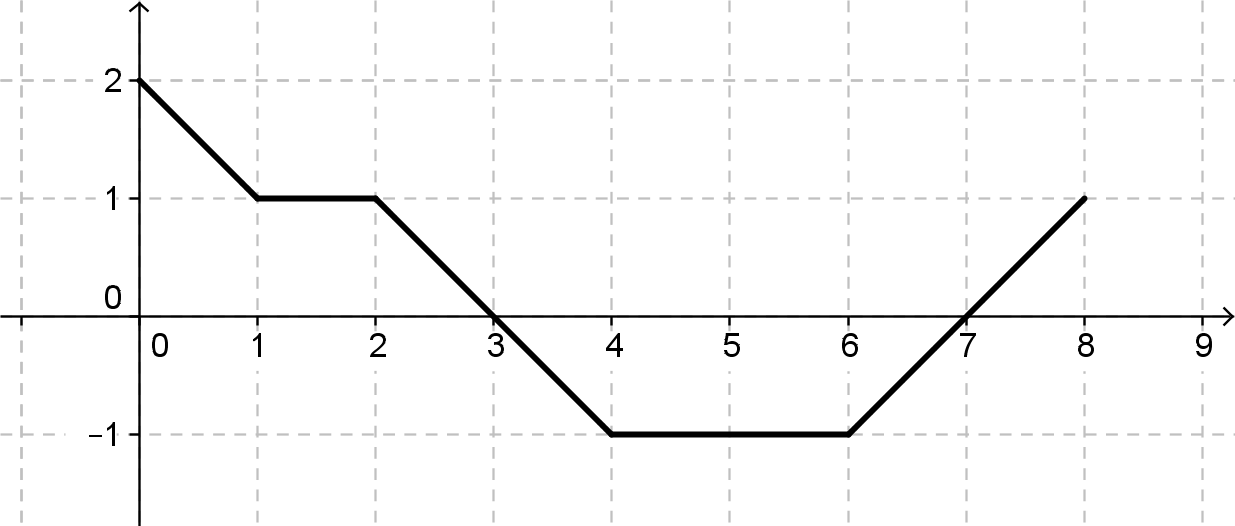
Evaluate (a) \(\displaystyle{\int_0^3 f(t)\, dt}\) (b) \(\displaystyle{\int_3^7 f(t)\, dt}\) (c) \(\displaystyle{\int_6^8 f(t)\, dt}\) (d)\(\displaystyle{\int_0^8 f(t)\,dt}\)
(e) Let \( \displaystyle{g(x)=\int_0^x f(t) \, dt}, \) where \(f\) is the function whose graph is shown above. (i) What is \(g(2)\)? (ii) At what value of \(x\) does \(g(x)\) have a local maximum? (iii) On what intervals is \(g(x)\) increasing? Explain.
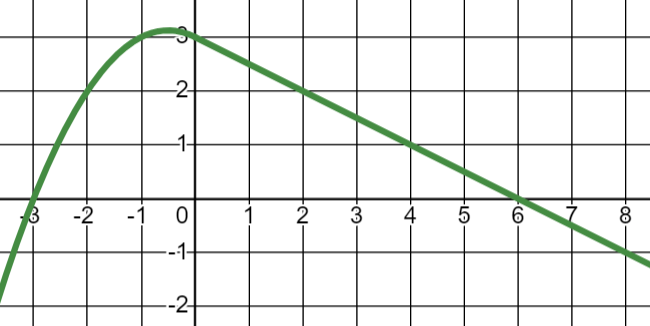
- Consider the following graph \(y=f(t)\). Let \( \displaystyle{g(x)=\int_0^x f(t) \, dt} \) and \( \displaystyle{h(x)=\int_{-2}^x f'(t) \, dt} \) for \(x \geq -3\). (a) Find the critical numbers of \(g(x)\) on the interval \(0 \leq x \leq 8\). Justify your answer.
(b) Evaluate \(h(6), \, h'(6)\) and \(h''(6)\). solution
- Evaluate each integral. solution
(a) \(\displaystyle\int x^3\,dx\) (b) \(\displaystyle\int e^x\,dx\) (c) \(\displaystyle\int \frac{1}{x}\,dx\) (d) \(\displaystyle\int \sqrt{x}\,dx\) (e) \(\displaystyle\int \sqrt[3]{x^2}\,dx\) (f) \(\displaystyle\int dx\) (g) \(\displaystyle\int 0\,dx\) (h) \(\displaystyle\int 2\,dx\) (i) \(\displaystyle\int \pi^2\,dx\) (j) \(\displaystyle\int e^3\,dx\) (k) \(\displaystyle\int x^{99}\,dx\) (l) \(\displaystyle\int \frac{1}{x^4}\,dx\) (m) \(\displaystyle\int 3^x\,dx\) (n) \(\displaystyle\int 5\cdot 2^x\,dx\)
- Evaluate each integral. solution
(a) \(\displaystyle{ \int (1 + 2x + e^x) \, dx}\) (b) \(\displaystyle{\int \frac{x-1}{\sqrt x} \, dx}\) (c) \(\displaystyle{ \int (x^7-5x^2+2x-3) \, dx }\) (d) \(\displaystyle{\int \frac{1+x+x^2}{x} dx}\)
Evaluate the following definite integrals.
- (a) \(\displaystyle{ \int_0^1 (1+x^9+x^{99})\: dx}\) (b) \(\displaystyle{ \int_0^2 (3x^2-1)\: dx}\) (c) \(\displaystyle{ \int_1^8 \sqrt[3]{x}\: dx}\) solution
- (a) \(\displaystyle{\int_{\ln 2}^{\ln 7} e^{x} \:dx}\) (b) \(\displaystyle{ \int_0^{\ln 5} (e^x-1) \: dx}\) (c) \(\displaystyle{ \int_{-1}^0 (2x-e^x+1) \: dx} \) solution
- (a) \(\displaystyle{ \int_{\pi/4}^{\pi} \, \sin (\theta)\, d\theta}\) (b) \(\displaystyle{ \int_0^{\pi/4}\, 8 \sec^2 (\theta) \, d\theta}\) (c) \(\displaystyle{ \int_{\pi/6}^{\pi/3}\, 8 \csc (t) \cot (t) \, dt}\) solution
- (a) \(\displaystyle{ \int_0^2 (3x^2-1) \, dx}\) (b) \(\displaystyle{ \int_{-1}^0 (2x-e^x+1) \, dx} \) (c) \(\displaystyle{ \int_0^{\pi/4}\frac{1+\cos^2\theta}{\cos^2\theta} \, d\theta} \) solution
- (a) \(\displaystyle{ \int_0^1 \frac{2}{1+ t^2} \, dt}\) (b) \(\displaystyle{ \int_0^9 \sqrt{2x} \, dx} \) solution
- (a) \( \displaystyle{\int_ 1^{64} \frac{1+\sqrt[3]x}{\sqrt{x}} \, dx }\) (b) \(\displaystyle{ \int_1^9 \frac{x-1}{\sqrt{x}} \, dx}\) solution
- (a) \(\displaystyle{ \int_1^{e^2} \frac{5}{x} \, dx}\) (b) \(\displaystyle{ \int_0^{\ln 5} (e^x-1) \, dx}\) solution
- (a) \(\displaystyle{ \int_{-3}^1 e^{v+5} \, dv} \) (b) \(\displaystyle{ \int_{0}^2 (6x-3)(8x^2+3) \, dx} \) solution
- The velocity function for a particle moving along a line is given by \( v(t)=2t-6\) meters per second on the time interval \( 1\leq t
\leq 4\). (a) Find the displacement and (b) the distance traveled by the particle during the given time interval. solution