The mating system of saltmarsh sharp-tailed sparrows
 (Carina Gjerdrum photo)
Unlike almost any other songbird, male saltmarsh sharp-tailed sparrows don’t sing loud songs, don’t defend territories, and don’t form long term bonds with females. Instead, their mating system has been characterized as scramble-competition polygyny: when the females are ready to mate, they may mate with any male, and the males, instead of fighting each other openly for access to females, are competing quietly, trying to outmaneuver other males to fertile females.
But who do the females end up mating with? Do they play favorites? Do they end up mating more or less at random, first come first served? Are some females faithful to one male? And why? At this point, we just don’t know.
It takes a pretty powerful suite of genetic markers to trace offspring to fathers in a situation like this, where the father could be any of a large number of males. , sorting out who is related to whom is hard in a situation like this. Carina Gjerdrum and Chris Elphick have been studying reproductive success of saltmarsh sparrows in Connecticut. In the summers of 2003 and 2004 Carina and her crew took blood samples from chicks at nests, caught and also took samples from the mothers at these nests whenever possible, and took blood samples from all adult males they caught in the area. Using those samples, I will be working to assign paternity in that population. Katie Copenhaver (a recent CCU graduate who worked with me in the spring of her junior year) and Whitney Bryan, a student from the South Carolina Governor’s School for Science and Math, have both contributed significantly to thisproject.
Questions about this project, or do you want to get involved? Contact Chris Hill
Population Genetics of Seaside Sparrows
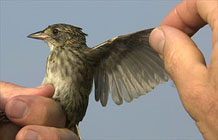
North American tidal marshes are unique in the world – unlike other similar habitats elsewhere in the world, North American saltmarshes have been extensive and enduring enough for terrestrial vertebrate species to have moved in and ended up completely dependent on them. Seaside sparrows are perhaps the ultimate salt-marsh obligate – the only places they live and breed are tidal marshes along the Gulf and Atlantic Coasts of North America, from Texas to Maine, and living in saltmarshes seems to have shaped them morphologically and physiologically.
Geographically, saltmarshes form a narrow linear strip of habitat patches along the coast, separated by gaps of non-marshy coast, like a long archipelago of “ecological islands.” I’m interested in documenting how much mixing goes on across different sized gaps in this range. Seaside sparrows south of the Chesapeake Bay are year-round residents in or near their breeding marshes, and banding studies show little movement. Does increasing fragmentation and destruction of coastal marshes threaten local populations of seaside sparrows, or do sparrow readily emigrate across gaps in their habitat? It’s been convincingly shown that seaside sparrows from the Gulf coast haven ‘t mixed with sparrows from the Atlantic coast for a very long time, perhaps hundreds of thousands of years. How about over shorter distances? Is a 100 km gap insurmountable? How about 10 km?
With the help of many students, most prominently Kelly Vowels and Christina Irving, I have developed molecular genetic markers that I am currently using to measure genetic differentiation between populations of seaside sparrows from several parts of the sparrow’s range. Will Post in Charleston, SC and Chris Elphick in Connecticut have collaborated by supplying blood samples from populations they are working on.
Questions about this project, or do you want to get involved? Contact Chris Hill
Study skin preparation
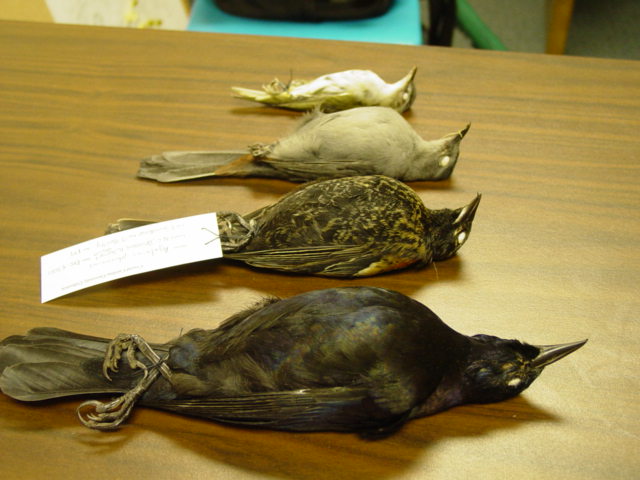
I have a freezer full of salvaged and donated birds, many of which I would like to incorporate into CCU’s teaching collection as study skins. I can teach the right person to prepare study skins, and I have money to pay an interested student to do this work. This would be a great job for a student interested in birds – you’ll learn a lot about bird anatomy. If you’re interested in skinning birds, contact Chris Hill.